
A Practical Mexico City Travel Guide: 12 Important Tips
If you are considering a visit to Mexico City, you should definitely go. We spent three weeks in Mexico City earlier this year and loved it! You’ll find so much to see, so much to do, and so much to eat! But Mexico City is a big place. In fact, it’s the second largest city in the Americas. And navigating the logistics of traveling in such a large city can sometimes be intimidating for travelers. But don’t worry! Here’s my Mexico City travel guide to help with some of the more practical aspects of visiting this great city.
Some of the links in this post may be affiliate links. If you buy something after clicking one of these links, I may earn a small commission. This does not cost you anything extra and helps support this blog.
Contents
Is Safety A Concern?
Certainly the first question that comes to mind when considering travel to Mexico City is often about safety. And so I’ll begin my Mexico City travel guide by addressing this topic first.
Is Mexico City safe?
Like any big city, you need to be smart in Mexico City when it comes to your personal safety. You should stick to safe neighborhoods, you should protect your personal belongings from pickpockets in crowded areas, and you shouldn’t wander dark streets alone (especially if intoxicated). This is the same advice I’ve given for every big city around the world on this blog.
With that said, I personally never felt unsafe in Mexico City. And I do like to wander and explore beyond the usual tourist sites. But I did always stick to the safer neighborhoods. And in those areas, I always noted normal people going about their normal everyday business, along with a robust police presence.

Twice, I found myself needing to walk through more isolated streets after eating dinner (I was Questing for the Best Tacos in Mexico City). I probably would have been safe, but rather than taking a chance, I simply ordered an Uber. That’s an easy way to ensure your safety if you are ever concerned.
Best Neighborhoods For Tourists
So then the natural followup question is – what are the safe neighborhoods in Mexico City? And which neighborhood is best for basing your visit?
The typical Mexico City travel guide will likely point you towards Roma Norte and La Condesa. And I won’t disagree. These are generally considered two of the safest neighborhoods for tourists since they are the most gentrified. Both are relatively central to all of the city’s best sites, and both offer lots of dining & shopping options. And whenever I visited those two neighborhoods, I noticed almost as many foreigners as locals.
Polanco is the most upscale neighborhood in Mexico City. But it’s not as central, so you’ll find yourself spending more time in traffic while sightseeing. Plus, I personally found that it lacked charm – since it’s more upscale & modern.

Coyoacan is another safe neighborhood for tourists. Unlike Polanco, Coyoacan is very quaint and charming. It also features several key sites, including two Frida Kahlo museums. However because of its distance from Mexico City’s center (about 40 minutes by Uber), I don’t think it’s a practical choice. I do have a blog post with more details about visiting Coyoacan if you would like to learn more.

During our own time in the city, we stayed in an amazing building located directly on the city’s most important boulevard called Reforma. This building was on the edge of the city’s Centro Historico district. (Here’s a link to our Airbnb rental which I very much recommend.)

I spent lots of time in the surrounding neighborhoods of Juarez, San Rafael, and Colonia Cuahutemoc without any safety concerns. I was very happy with this area because it was perfectly central for sightseeing, and an easy walk into Centro Historico.
Mexico City’s Top Sites
Speaking of sightseeing, what are the most essential things to see in Mexico City?
Well, a question like that is beyond the scope of this Mexico City travel guide covering practical travel tips. Instead, I’ve written an entire separate blog post entitled The 10 Most Essential Things To Do In Mexico City.
However, rest assured that Mexico City is filled with remarkable sites. Sites like the Aztec Templo Mayor which sits adjacent to the city’s 16th century Cathedral…

Mexico City has nearly 200 museums – second most of any single city in the world (London is in first place). These include the National Archeological Museum with its fantastic collection of artifacts from across Mexico’s history…

And you don’t want to miss one of the most amazing ancient historical sites we’ve ever visited – the ancient city of Teotihuacan and its famous pyramids.

Be sure to check out that aforementioned blog post to learn about even more great things to do and see in the Mexico City.
Tourist Sites Are Spread Out
Something important to point out in this Mexico City travel guide is that the popular tourist sites are spread out across this huge city. When you look at Google Maps, it’s hard to get a handle on Mexico City’s size until you get there.
When we were in Spain’s capital city, we could pretty much walk to every major Madrid site since everything to see was centrally located. This is not the case in Mexico City. To walk from the Palacio de Bellas Artes to Chapultepec Castle (two very popular sites) it would take 75 minutes. To walk from the center of Roma Norte to the Templo Mayor would take an hour.
So you will be using public transportation or Uber to get around Mexico City. You will want to generally plan on 20-30 minutes to get between sites in the central part of town. And you’ll want to reserve 40-60 minutes for outlying areas like Coyoacan & Xolchimilco.

Traffic in Mexico City Is Next Level
When it comes to getting around Mexico City, you should know that traffic in Mexico City is next level! It’s the worse I’ve come across in our travels so far.
Here’s an example of an intersection one day near Centro Historico. Cars weaved together while going in multiple directions. All at a temporary standstill. Horns blaring. Drivers yelling. It’s crazy!!

And it can change on a dime. The above scenario happened when a major street suddenly closed – which seemed to happen frequently.
Of course it’s all even crazier during Mexico City rush hour, which typically peaks from 7-9:30 in the morning and 6-9 in the evening. We learned very quickly to avoid going anywhere by vehicle during those hours. One night it took me 30 minutes to go two miles in an Uber.
I also learned that any approximation of arrival times on Google Maps is a very loose approximation – because things can change so quickly. The Uber App seemed to do a better job at knowing to add extra time with its initial estimate. So consequently, Uber would often get us someplace faster than promised.
But not always. In fact, on the Sunday morning we departed Mexico City for Puebla, it took almost twice as long originally indicated in the Uber App to reach the TAPO Bus Station. So if you remember only one thing from this Mexico City travel guide, ALWAYS plan on extra travel time if you need to be somewhere by an absolutely certain time.

Uber is Your Best Transportation Option
So you’ve probably gathered by now that we used Uber a lot in Mexico City. I did find that it was the most convenient way for getting around the city.
I’m a big fan of public transportation and try to use it everywhere we go. Mexico City does have an extensive Metro and bus system, and we did use those occasionally. However, Uber in Mexico City is relatively inexpensive. Plus, it was generally an easier and faster way to get from point A to point B. Even with traffic taken into consideration.

When we did use public transportation, I found it completely safe. But the buses were always packed like sardines. And while the Metro wasn’t terribly crowded (except at rush hour), the Metro stations didn’t often line up with where we wanted to go (without transfers or lots of walking). Uber was just overall so much easier.

The cost of our average Uber rides within the city center cost around 3-6 USD. For farther destinations like the airport or Coyoacan, it typically only cost around 15 USD.
And of course, Uber is always easier than a taxi. But as every Mexico City travel guide will tell you – if you do need to use a taxi, never hail one directly off the street for safety reasons. (You may also want to be aware that the ride share platform Didi is a popular choice in Mexico City too.)
If you would like to learn more, then check out my post specifically dedicated to using Uber In Mexico City.
How Well Should You Speak Spanish?
Certainly one of the advantages of using Uber to get around is that no Spanish-speaking ability is necessary. But what about other situations in Mexico City? Do you need some Spanish-language ability in order to navigate the city as a tourist?
Of course, some Spanish ability would be ideal. I did find myself in plenty of situations where no English whatsoever was spoken. Though I do have the tendency to go off the beaten track sometimes.
However, in the most popular touristic sites, some English was usually spoken. And I was offered an English menu (or directed towards a QR code for an English menu) about 60% of the time. However, do not expect the same level of English language accommodation that you’ll find in the popular Mexican resort cities.
As I’ve recently outlined in my blog post about Dreaming Spanish, I am actively learning the Spanish language, and do have intermediate comprehension skills. And I found this ability to be extremely useful. I encourage anyone interested in learning Spanish to use Dreaming Spanish.
But if you have no Spanish-speaking ability whatsoever, Google Translate makes language exchange much easier than it used to be.
So don’t worry if you don’t know Spanish. You’ll be fine!

Should You Be Concerned About Earthquakes?
Any Mexico City travel guide would be incomplete without mention of earthquakes. Mexico City is known for its frequent seismic activity, and the city experiences several perceptible earthquakes every year. Most of these earthquakes do not occur within the city itself. They usually occur elsewhere, but then shake the city due to its unique geography (the city is built on a dry soft lake bed).
If you do experience an earthquake while traveling in Mexico City, odds are that it will be small and will not cause significant damage. The last major earthquake to hit Mexico City occurred in 2017 (magnitude 7.1)
But you can also feel confident that Mexico City takes earthquake preparedness seriously. In every single building, you will see signage with earthquake safety instructions.

And you will also see earthquake safe zones marked throughout the city. These are places considered safest to stand if you are outside when the shaking starts. Which is useful…because in Mexico City you will actually have some warning.

The city has an earthquake early warning system called SASMEX. This is an alarm system that triggers over loud-speakers and on cell phones if an earthquake is on its way from elsewhere (radio waves travel faster than seismic waves). SASMEX can often provide a 60 second warning – which might be enough time to ensure you are in a safer place when an earthquake hits.
In fact, we were awakened one night from a deep sleep by the SASMEX system. It was a 4.9 earthquake somewhere near Acapulco. We ultimately never felt anything. Though I will admit, it was a bit nerve-racking.
Therefore, if you have a true earthquake phobia, Mexico City may not be your best destination. Otherwise, study those earthquake safety signs, and have a good time.
How Bad Is The Air Pollution?
Let me mention another environmental hazard in this Mexico City travel guide. For a number of years, Mexico City was quite famous for its air pollution. In 1992, it was named the most polluted city in the world. However, big strides have been made over the years to clean up the city’s air.
So how was the air quality during our January visit? Honestly, not great.

However, my home town of Salt Lake City often has some of the worst air quality in the United States – especially in the winter. So everyday I would compare the two on IQAir.com….just for fun. And usually Salt Lake City’s air quality was worse than Mexico City’s (in January).
But our allergy symptoms were worse in Mexico City than at home. And our eyes did burn constantly. I’m guessing that this was due to a much higher degree of auto-related pollutants.
Anyway, you definitely need to be aware of this if you are sensitive to pollution from a respiratory standpoint. And if you have common allergies, then don’t forget your steroid nasal sprays and antihistamine eyedrops.
Also Be Aware Of The Elevation
And speaking of home comparisons, my house sits at nearly 5000 feet above sea level. Mexico City sits at 7350 feet. Consequently, the high altitude wasn’t an issue for me.
However, if you are coming from lower elevations, Mexico City’s high altitude probably will be an issue initially. I heard several other travelers talking about the mild fatigue and dizziness they experienced in their first few days.
So as a retired physican writing a Mexico City travel guide, here are my recommendations. If you are traveling from a lower altitude, I would not cram your Mexico City itinerary for the first few days. Ease into your time at the city’s high altitude. Avoid alcohol at first. And stay extra hydrated.

Can You Drink The Water in Mexico City?
The need to stay hydrated inevitably raises the question about water safety in Mexico City. And no, you shouldn’t drink the tap water in Mexico City. We didn’t even use it for brushing our teeth.
It is not difficult to find bottled purified water wherever you go. You can also be confident that restaurants use purified water as well. And this includes the ice you are served.
I did not experience any traveler’s diarrhea during this month long stay in Mexico (which included time in Puebla too). Neither did Mrs. TT.

So What About Street Food?
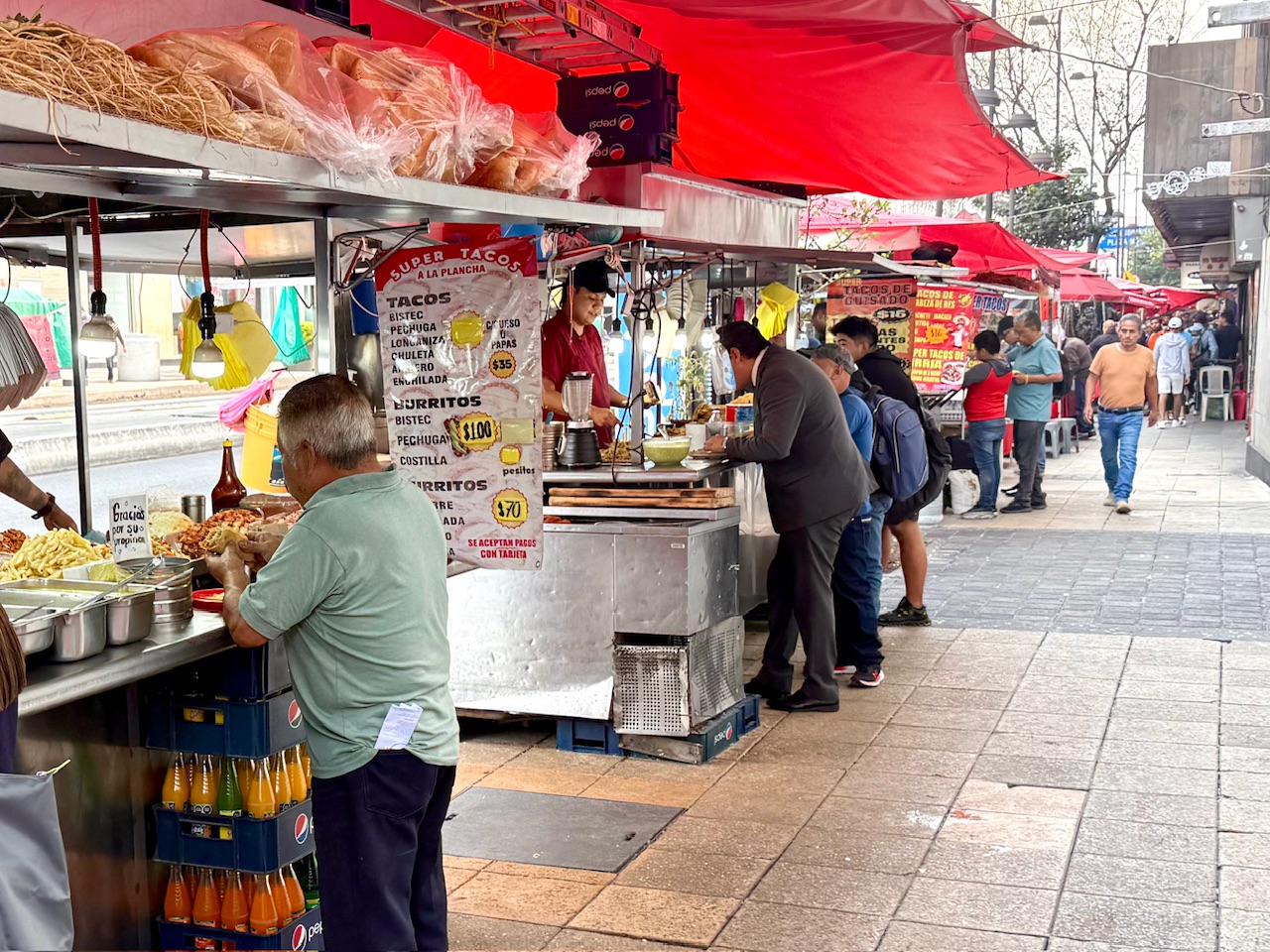
Mexico City is famous for its street food. And street food kiosks are truly everywhere. Local residents line up at all times of the day to eat from these stands. And the typical Mexico City travel guide will tell you that it’s generally OK to eat street food as long as you choose wisely.

But I’m writing an honest Mexico City travel guide based on my personal experience. And I honestly struggled with eating street food during our time in the city.
I consider myself an adventurous eater. And I thought I’d be eating from street carts in Mexico City more than I did. But being a retired physician can get in my way sometimes. The immune system of a visitor may not be prepared for the same bacterial exposure that locals are accustomed to. (You should also be aware that both Hepatitis A and Typhoid vaccines are recommended if you will be eating street food frequently in Mexico City.)
I ultimately had difficulty finding street food kiosks that met my own strict food hygiene requirements. General lack of refrigeration is what bothered me most. Consequently, I only ate from two street food kiosks during our visit.
I did eat in one of Mexico City’s more famous food markets called Mercado de San Juan. I felt comfortable with all the kitchens inside that market, like this one at Los Sirenos Mariscos…

And I discovered that I could find almost every type of Mexico City street food inside local restaurants. I featured much of this great food in my post on the Traditional Food in Mexico City. This cost a little more than eating at street kiosks (which are very inexpensive). But as I just mentioned above, I did not experience any GI distress during our time in the city. So that was worth a lot! Below is a popular type of street food called Huarache that I ate inside a popular local restaurant chain called Taqueria Caiman.

Also, no matter where you eat in Mexico City, you should always use hand sanitizer or wash your hands with soap prior to eating. This is considered one of the most important ways to reduce GI illness in Mexico, and is practiced by most locals. I always carried a small bottle of hand sanitizer in my pocket. But most restaurants also had bottles for customer use.
Final Thoughts
So hopefully the practical tips in this Mexico City travel guide will help you plan an awesome trip to this great city. We really enjoyed our time in Mexico City, and I’m sure you will too!
If you would like to read more about our travels in Mexico, then be sure to check out these posts:
Tips For A Perfect Day Trip From Mexico City to Teotihuacan
Is Merida Worth Visiting? 10 Practical Points To Consider