
The Best Traditional Mexico City Food You Don’t Want To Miss
Mexico City is one of the world’s greatest food cities. And travel eating is one of my greatest joys. So naturally, Mexico City food was a highlight of my recent three week stay. But while Mexico City has gained increasing fame for its upscale restaurant scene (with a growing list of Michelin stars), and while TikTok influencers love featuring the city’s trendiest eateries, I set out to find the more typical places frequented by locals. And in so doing, I tried lots of different types of traditional Mexico City food. Here’s a look at all the great traditional Mexican food I found – and where you can get it yourself.
Some of the links in this post may be affiliate links. If you buy something after clicking one of these links, I may earn a small commission. This does not cost you anything extra and helps support this blog.
Contents
Tacos
It seems right to start off this compilation of great Mexico City food with tacos. Tacos are certainly the most famous of all Mexican food. And Mexico City is one of the great places in the world to eat them. You will see tacos everywhere – from the city’s thousands of street carts, to a multitude of taquerias, to just about every restaurant.
I ate lots of tacos in Mexico City. In fact, I even quested for the Best Tacos in Mexico City – similar to my Quest To Find The Best Tacos in Merida. And I’ll write a blog post about my Mexico City Taco Quest eventually. But for this more generalized food post, let’s simply look at some of the most popular types of tacos in Mexico City.
Al Pastor Tacos
Al Pastor Tacos are considered the very most popular type of taco in Mexico City. Al Pastor meat is pork marinated in a paste made from chiles and achiote (which gives the red color). The meat is cooked on a vertical spit called a trompo. The Al Pastor is then shaved off the trompo and served with grilled pineapple, cilantro, and onions. Plus, it usually comes with a variety of salsas as well. You can find Al Pastor all over the city. The tacos below are from a popular taqueria chain called Taqueria Orinoco.

Trompo Negro Tacos
Below, you’ll see a photo of three different trompos, each with a different type of meat. You can see the red Al Pastor on the left. But the darker trompo on the right is called Trompo Negro.

Trompo Negro was my personal favorite type of taco in Mexico City. This taco also uses pork, but the marinade features a paste made from charred chilis. I thought the flavor was more complex than Al Pastor tacos. And consequently, I ate them more often. You won’t see Trompo Negro around town as commonly as Al Pastor. But when you do, don’t miss out! The version below is from another popular taqueria chain called Tacos Atarantados.

Suadero Tacos
Suadero tacos are hugely popular in Mexico City. In fact, there’s an entire episode of Netflix’s Taco Chronicles all about the city’s Suadero taco scene. These tacos are made with beef using a fatty cut from the cow’s belly.

The Suadero beef is slow-cooked for several hours in fat, using a special type of dome-shaped pan called a choricera. The tender meat is then chopped up when served. The tortillas used for this taco are usually soaked briefly in the cooking fat, adding to the overall flavor profile. (You can see the wet tortillas in the photo above.)

I thought Suadero tacos were good, but they weren’t my favorite. They were generally fattier than I personally prefer. But still, they are an essential Mexico City food that you definitely need to try. You will find choriceras slow-cooking Suadero all over the city. The two photos in this section are from a well-known street stand called Taqueria El Paisa – which is even recommended in the Michelin Guide.
(However this is not the famous Mexico City taco shop that was actually awarded a Star by the Michelin Guide. That’s called El Calife De Leon and I’ve written a blog post all about my experience eating there.)
Guisado Tacos
You won’t see this type of taco nearly as often as Suadero, but it’s definitely worth trying if you do. It’s called Guisado – which is the Spanish word for stew. These tacos feature various types of stew served on top of rice. When you eat at a Guisado taqueria, you’ll typically have several different stews to choose from.
The flavorful stew below consisted of beef, bacon, onions, and various types of bell peppers. I ate this taco at a market stall while on an organized tour of the Iztapalapa Cable Cars (which I very much recommend – here’s the link). But you can also find a Guisado taqueria in La Condesa called Tacos Hola El Güero (also recommended in the Michelin Guide.)

Gringas
Gringas are a Mexico City food that is an alternative to the typical Al Pastor taco. These use a folded and toasted flour tortilla instead of the smaller corn tortillas. Gringas are traditionally filled with Al Pastor, pineapple, and gooey cheese. Yes it does sound like an Americanized version of the Al Pastor taco. And yes, that’s why it is named Gringa. (The version below is from Taqueria Orinoco again.)

The Gringa origin story is this: American expats in Mexico City started asking that their Al Pastor tacos be made in this Tex-Mex fashion. Eventually, the style caught on with the locals as well. In fact, the Mexico City restaurant chain El Fogoncito claims to be the accommodating inventor. Below is a photo of their Shrimp Gringa that Mrs TT ordered one day. Gringas are now an extremely popular Mexico City food, and you’ll find them at both street carts and in restaurants.

Flautas Ahogadas
The first time I ever ate Mexico City food was when I was 11 years old and my family visited the city. I’ve talked about this travel experience elsewhere on this blog. And the dish I remember most from that trip is Flautas. They were so different than any sort of Mexican food I’d ever eaten before. And I loved them! I still do!
Flautas are long rolled corn tortillas that are stuffed with various ingredients and then deep fried for a hard crunchy bite. Fluata is the Spanish word for Flute because the food resembles the instrument.
Flautas Ahogadas are flautas drowned in salsa. My version below is drowned in salsa verde and topped with crema. This was an order of mixed Flautas. Each one was stuffed with something different – shredded chicken, shredded beef, and mashed potatoes. These are from La Casa de Toño. This popular restaurant chain became my favorite place for discovering a wide variety of inexpensive traditional Mexico City food.

Also note the Guacamole in the photo. If you love Guacamole (and who doesn’t), you’ll be happy to know that it’s on nearly every menu in Mexico City!
Volcanes
Volcanes are similar to Tostadas, but with a key difference. The base is a crispy grilled corn tortilla. But as this tortilla is grilled, cheese is added on top. Then as the cheese bubbles, the edges of the tortilla turn up. Because these then resemble volcano craters with bubbling lava, they are called Volcanes (Spanish for volcano). When finished cooking, they are topped with refried beans, meat, and other toppings. The version below includes Al Pastor, and is from the aforementioned Tacos Atarantados.

(In other parts of Mexico, these are called Vampiros since the turned up edges also resemble bat wings.)
Alambres
Alambres are a mixture of grilled meat, onions, and bell peppers, served on top of corn tortillas. The idea is to then to use the tortillas and eat the mixture like tacos. It’s a similar concept to the Tex-Mex fajita, but not exactly, since all the ingredients are mixed together on the grill first. You will commonly see this particular Mexico City food offered at the city’s many street carts. But you can also find it in restaurants – like this chicken version I ate at El Fogoncito. They seemed to specialize in Alambres as much as they did in Gringas.

Huaraches
Another really popular street food in Mexico City is Huaraches. Huarache is the Spanish word for sandal, and this particular Mexico City food is shaped like one. The key feature of the Huarache is its oblong base. It’s a thick chewy tortilla filled with a thin layer of refried beans. When ordering a Huarache you can choose from many different meat options. The one below is a Chicken Tinga Huarache. Chicken Tinga is shredded chicken mixed in a smokey chipotle tomato sauce. Huaraches are then typically topped with lettuce, cheese, salsa, and crema.

While Huaraches are a very popular street food, you will also find them at many restaurants too. The one above is from yet another local chain of restaurants called Taqueria El Caifan.
(You may have noticed by now that I was generally more comfortable eating at local restaurants than at street carts. You can find almost every popular type of Mexican street food in typical restaurants catering to locals.)
Quesadillas
Quesadillas are a type of Mexico City food that shouldn’t need any explanation. Like tacos, they are popular worldwide. However you should know that Quesadillas aren’t automatically served with cheese in Mexico City. You generally need to specify that you want Queso.

I also want to point out the ingredient spilling out of my Quesadilla above. It called Huitlacoche – also known as Corn Fungus. This is an ingredient that dates back to Aztec times and is still very popular in Mexico today. It is indeed a fungus that grows on corn and its highly nutritious. I’d read that it can taste like truffles. But I personally didn’t think it tasted anything like truffles. I thought it was quite mild, and tasted like a mixture of corn and mushrooms.
Enchiladas
Enchiladas are another common Mexico City food that doesn’t really need an explanation. Rolled & filled corn tortillas, covered with a chili sauce, and topped with cheese & crema. So I’ll just simply say that you can easily find enchiladas in Mexico City. And of course they are probably much better than any you’ll eat at home. Chicken seemed to be the most common filling, and you’ll typically have an option of red or green chili sauce. The very tasty version below is from a restaurant on our day trip from Mexico City to nearby Teotihuacan called Restaurante Rincon Teotihuacan.

Enfrijoladas
Enfrijoladas are very similar to Enchiladas. But instead of a chili sauce, they are covered with a flavorful bean puree. This is a breakfast version of the dish, filled with eggs and topped with chorizo from a local restaurant chain called Toks.

Enmoladas
And finishing up the “ladas” trilogy of Mexico City food is Enmoladas. These are similar to the other two “ladas”, but are topped with Mole instead. Here’s a version from Corazon de Maguey – a restaurant in Coyoacan (a southern neighborhood of the city). These chicken-filled tortillas are covered with three different kinds of moles – Pipian (red), Verde (green), and Negro (black).

I’ve written about my love for Mole on this blog several times before. And Mole is a popular type of Mexico City food in its own right. You’ll find this classic and very complex sauce offered in many restaurants – often served with chicken and rice. However, we also went to Puebla on this trip. And one of Mexico’s most renowned Moles was invented in Puebla (Mole Poblano). So I’m going to save any further Mole talk until my Puebla posts.
Chilaquiles
One of the most common breakfast foods in Mexico City is Chilaquiles – though you can generally order them from many local restaurants at any time of the day. This popular type of Mexico City food is a plate filled with tortilla chips that have been simmered in a red or green chile sauce until softened. These are then topped with crumbled cotija cheese and crema. You can also have a protein added if you wish (eggs or shredded chicken were common choices). The photo below shows a version from El Bajio – another great local restaurant chain offering a wide selection of Mexican classics.

Barbacoa
Another breakfast classic in Mexico City is Barbacoa. But Barbacoa is typically reserved for Saturday and Sunday mornings. Barbacoa is sheep or lamb that is slow-cooked overnight in an underground pit. It’s then served fresh the following morning as tacos. It’s usually accompanied by a consommé made from the drippings.

I ate the above Barbacoa one Sunday morning at 8:00am in a small restaurant called Barbacoa Edison. It was one of the very best meals from our time in Mexico City! It was unquestionably the most tender lamb I’ve ever eaten, and the consommé was packed with flavor. If you are in town on a weekend, do not miss this great type of Mexico City food!
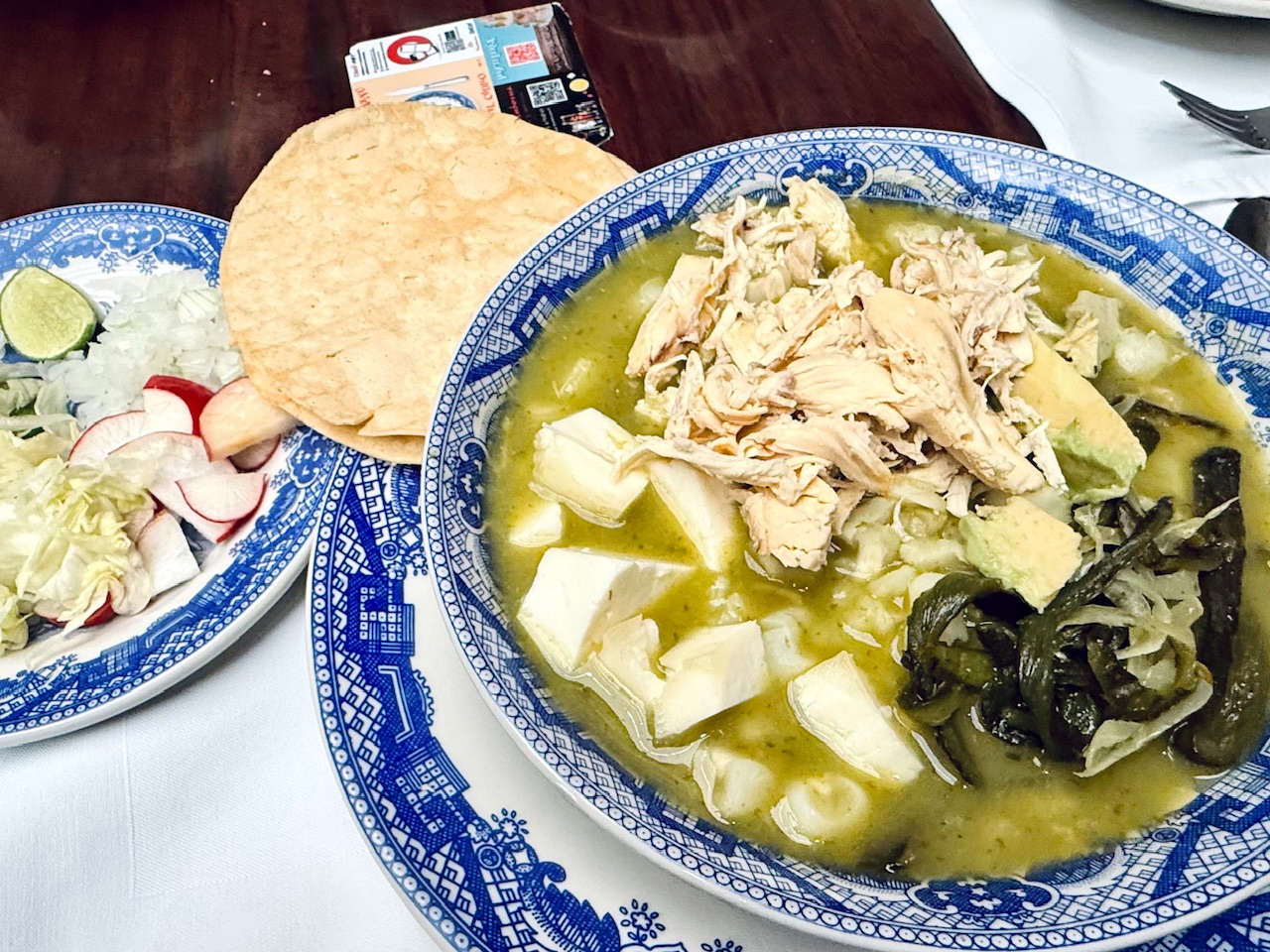
Pozole
Pozole is a classic Mexican soup that dates all the way back to pre-Hispanic times, and was supposedly served during Aztec religious ceremonies. Nowadays, it’s one of the most popular dishes that you’ll see throughout Mexico City.
One of Pozole’s key ingredients is Hominy – soft, chewy corn kernels without their hull. Pozole also usually contains a protein – either shredded chicken or pork. And then the soup features a broth made from chilis – either Rojo (red) or Verde (green). You can sometimes find a chili-free white version too. This hearty soup is usually served with lettuce, radishes, onions as a topping. Along with side of crunchy tostadas.


Pozole was one of my favorite types of Mexico City food. In fact, prior to leaving for the airport, I ate one last bowl at La Casa de Toño.
Mixiote
Mixiote is another classic Mexican dish that dates back to the Aztecs and other indigenous pre-Hispanic cultures. It features meat that’s been marinated in a sauce of chilis, garlic, and other spices and then cooked in parchment paper. It also usually contains Nopales (prickly pear cactus). Traditionally, agave leaves were used to cook mixiote, but that practice is no longer sustainable.
This is a version of Mixiote with Chicken from the aforementioned Restaurante Rincon Teotihuacan near the Pyramids. It was so delicious and packed with flavor!

Seafood
So far, most of this Mexico City food has featured meat. But what do you eat if you’re a seafood lover visiting Mexico City? Don’t worry! You will not be disappointed! Great seafood is not hard to find…including fish tacos. We ate fish and other seafood regularly during our time in town. Here are just a few examples.
Grilled Fish
Regular readers know that I love grilled fish. And it was not hard to find grilled fish in Mexico City. The plate below is from a seafood restaurant in Roma Norte called Mony Mariscos. It’s grilled Grouper covered in a generous red chile garlic rub. It was pretty much perfect. And not as spicy as it might look.

Ceviche
Regular readers also know that I love Ceviche. And while not traditionally Mexican, ceviche is offered at most seafood restaurants in Mexico City. This was a delicious batch that I enjoyed at Camarón Buchón – a popular chain of seafood restaurants in the city.

Caldo de Camarón
Caldo is a Spanish word for soup. And you can find several different types of Caldos with seafood in Mexico City. The version below is my Shrimp Caldo from a highly-rated seafood restaurant called Los Sirenos Mariscos – located inside the city’s famous Mercado de San Juan.

Conchas
Let’s finish up this overview of Mexico City food with two sweet treats. The first is the Concha – considered the most popular bakery item in the city. You truly will see it everywhere. It’s called Concha because it looks like a seashell (concha is the word for seashell in Spanish). And it’s pretty simple – just a sweetened soft bread roll, topped with a hard sugary crust. The crust, which gives the Concha its shell-like appearance, generally comes in two flavors – vanilla or chocolate.

One of the most popular places to get Conchas in Mexico City is Pastelería Ideal – founded all the way back in 1927. This pastelería is the busiest bakery I’ve ever seen, and well worth a stop. The bakery itself is huge. The selection of baked goods is honestly overwhelming. And every time I passed by, the bakery was packed with locals piling their trays with a variety of different baked goods.

Churros And Chocolate
And then finally, you can’t visit Mexico City without eating Churros and Chocolate at El Moro. This iconic Mexico City Churreria was founded in 1935 by a Spanish immigrant who started selling a taste of his homeland in Mexico. Yes, that’s right…Churros originated in Spain. In fact, I wrote an entire blog post all about Questing for The Best Churros in Madrid.

I found that the churros at El Moro are a little longer and crispier than their Spanish counterparts. Plus they are covered in sugar and cinnamon, which isn’t common in Spain.

You can also choose to have your churros served with a cup of hot chocolate – exactly as I grew accustomed to in Spain. Hot chocolate is an ancient pre-Hispanic drink in Mexico, and a very common drink in Mexico City. I tried it in several different places. And I thought the chocolate at El Moro was the best I had.
Final Thoughts
Wow! I certainly ate a lot of different types of traditional Mexico City food during this visit. And I loved it all! The Trader Joe’s burrito I’m eating for lunch today won’t come close to matching any of it.
I hope this post will help guide some of your own eating adventures in Mexico City. And I’m sure you’ll enjoy eating your way around the city as much as I did.
If you would like more about traveling in Mexico City, then be sure to check out these posts:
The 10 Most Essential Things To Do In Mexico City
Tips For A Perfect Day Trip From Mexico City to Teotihuacan
If you would like to learn more about other types of traditional food from around the world, then be sure to check out these posts: