
I Used Dreaming Spanish For A Year – Did It Work For Me?
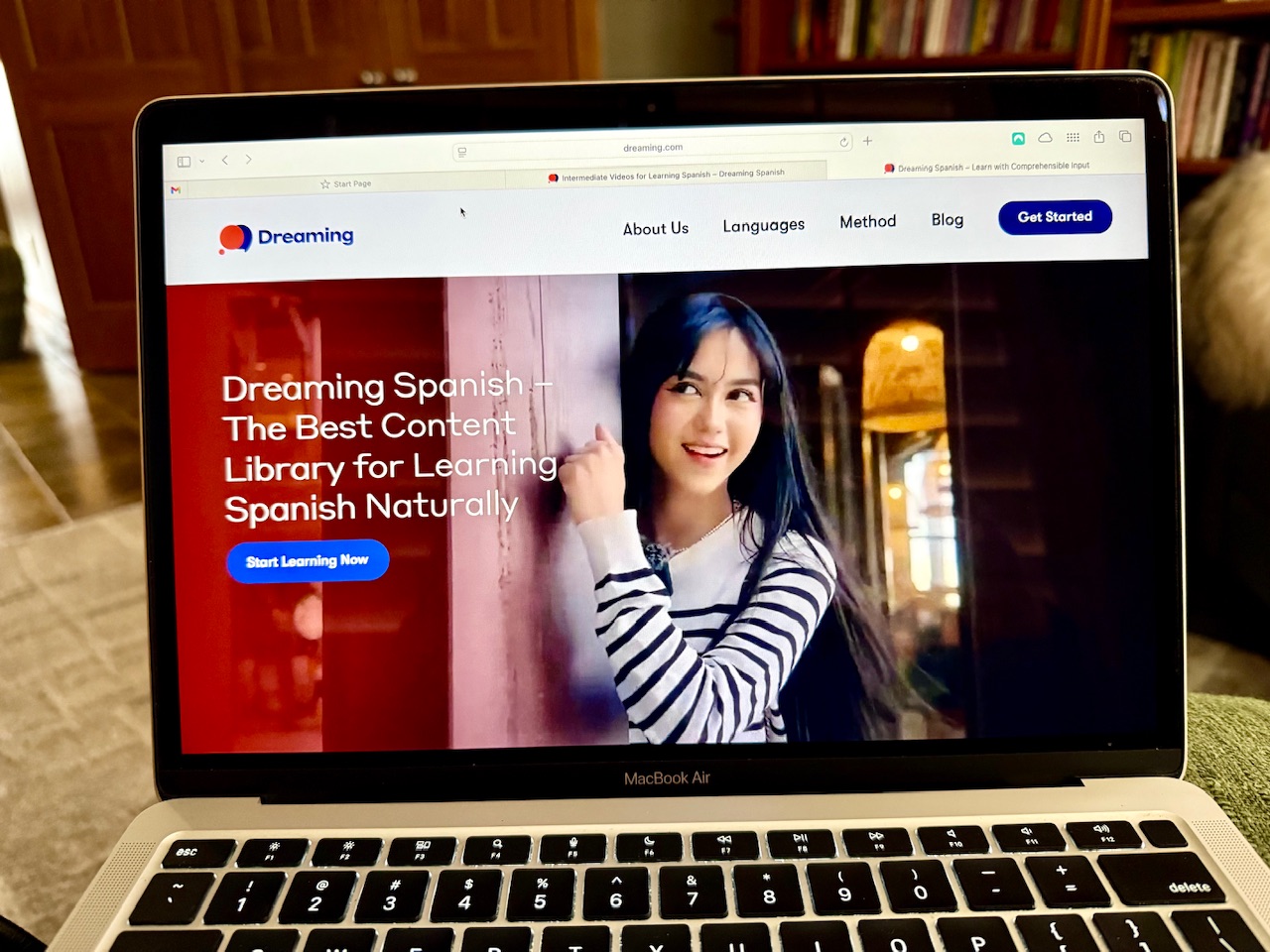
About one year ago, just a few days before we left to spend a month in Merida Mexico, I became aware of Dreaming Spanish. I wasn’t necessarily seeking out a program for learning Spanish. But once Dreaming Spanish was brought to my attention, I thought maybe I should give it try. After all, what frequent traveler would’t benefit from knowing another language? And since almost half of our international travels have been to Spanish-speaking countries, it did make sense to ramp up my Spanish-speaking game.
As I start this post, I’m actually sitting on a plane, returning home from a month in Mexico City and Puebla. Over the past year, Dreaming Spanish has become a regular part of my daily routine. Naturally then, the obvious question is – how have my Spanish skills evolved between these two trips to Mexico? And was the 406 hours that I’ve spent watching Dreaming Spanish videos in the last 13 months worthwhile? Empecemos!
Some of the links in this post may be affiliate links. If you buy something after clicking one of these links, I may earn a small commission. This does not cost you anything extra and helps support this blog.
Contents
What is Dreaming Spanish?
First, let me briefly introduce you to Dreaming Spanish. And I do want to point out that this is not a sponsored blog post. I am not writing this at the request of the company. I’m writing it as a fan.
Dreaming Spanish is an online program that uses the Comprehensible Input method of language learning. I won’t go into the learning science behind Comprehensible Input in this post – the Dreaming Spanish website does that much better than I can. But very briefly, when you use their site, you are simply watching Spanish language videos. You start learning solely via listening and observation – like a child does. And that makes perfect sense! After all, that’s how our brains are wired to learn a language.
The initial videos start very simply with what they call the Superbeginner Level. These videos feature very slow repetitive speech, simple every day topics, lots of associated hand gestures and pictures.
The Dreaming Spanish platform prescribes that you watch these simple videos for a certain number of hours – 50 to be exact. Ultimately you will start to understand more and more of this Superbeginner content. And then after 50 hours of watching, you’ll be ready to move up to Beginner Level.

At the Beginner Level, the speech speed increases, the sentence structure gets a little more complicated, and the topics become a little less basic. Pictures and hand gestures are still an important part of these Beginner videos to help get the point across.
Eventually, after 100 hours of Beginner videos, you’re ready to move to the Intermediate Level. Speech speed again increases, topics expand, and supporting pictures diminish. The Intermediate Level prescribes 450 hours of video viewing.
So far then, that’s 50 hours of Superbeginner, 100 hours of Beginner, and 450 hours of Intermediate. Once you’ve reached this total of 600 hours watching Dreaming Spanish videos, you’re ready to move up to the Advanced Level.
And this is when you start speaking and reading. Yes, that’s right! Dreaming Spanish does not encourage speaking until you’ve spent 600 hours watching videos. Again, there is lots of language science behind this. And I won’t go into all the details. But I encourage you to spend some time exploring their website for all the rational.
Are The Videos Boring?
No! Not at all! In fact, they are usually very entertaining. Dreaming Spanish has a core group of teachers from around the Spanish-speaking world. These are video content creators who live in Argentina, Spain, Colombia, Mexico, and the Dominican Republic.
The videos typically run anywhere from 3 minutes to 20 minutes, and cover a wide range of topics.
While watching these videos, you actually learn lots of interesting general information. Entire video series are dedicated to history, geography, anthropology, cooking, food, and local culture (as it pertains to each teacher’s home country).

And if you love travel like I do, you’ll definitely want to know that many Dreaming Spanish videos are dedicated to world travel. It’s like watching The Travel Channel (back when it actually had travel shows) in slow Spanish. The Argentine teacher named Agustina travels extensively and takes you along everywhere she goes.
Plus, many of the videos cover simple every day situations too.
While you navigate this huge range of video topics, Dreaming Spanish does not give you a set curriculum to follow. You simply choose whichever video and topic you happen to be in the mood for at the moment, using the website’s excellent filter function. And there are thousands of videos to choose from, with several new videos uploaded to the site every day.

When you start out with Dreaming Spanish, you can watch many of these videos for free. But full access requires a monthly premium subscription for a very reasonable $8 monthly.
My Own Past Language Learning Experience
Prior to starting Dreaming Spanish, I was able to speak a little Spanish. I called it “travel Spanish”. I could order some food, manage through basic greetings, and make my way through a market. But I understood very little when I was spoken to.
My Spanish skills would typically improve temporarily in Spanish-speaking destinations where very little English was spoken (like Buenos Aires Argentina and Cartagena Colombia). But it wouldn’t improve much at all in Spain where English is more common in touristy locations (and we even spent a full two months in Malaga and Madrid once).

I did try Duolingo once about 15 years ago. I used this popular method daily for almost an entire summer as I prepared for a week in Quito Ecuador volunteering in an orphanage. Once I arrived in Quito though, I was fairly disappointed with the Spanish skills I’d acquired via Duolingo, and never resumed the program. I could speak some memorized phrases. But again, I couldn’t really understand anything when spoken to.
At one point in my life (40 years ago), I was fluent in the Cantonese dialect of the Chinese language. I lived and worked in Hong Kong for about 20 months. I learned Cantonese through an intensive 2 month full-time program before traveling to Hong Kong. However when I arrived, it quickly became clear that I barely knew how to speak or understand Cantonese.
Ultimately, I learned. But not until I was receiving what I now recognize as Comprehensible Input from local speakers on a daily basis. And even then, it took about 6 months before I started to feel somewhat comfortable with Cantonese (which is a one of the most difficult languages to learn given its tonal characteristics.)
But as with all skills, if you don’t use it you lose it. And I now remember only a few Cantonese words and phrases.
Starting Dreaming Spanish in Merida
So, as we were preparing to leave for a month in Merida Mexico, and I became aware of Dreaming Spanish, I thought why not give it a try? It seemed like perfect timing.
I really enjoyed our time exploring Merida. A month in Merida is a long time. As I point out in my post Is Merida Worth Visiting?, there aren’t an abundance of sites in Merida. For us, it was more about enjoying the vibe of the city. And consequently, I found myself with plenty of opportunity for watching Dreaming Spanish videos.

And from the very start, I could see the value of their method. I started with a daily goal of 30 minutes. But before long, I’d increased that goal to an hour. And within two weeks, I decided to start the Premium subscription for broader video access.
And I did notice fairly quickly, that compared to our previous trips to Spanish-speaking destinations, I was feeling a little more comfortable and confident with the language in Merida. Even with only the simple Superbeginner videos.
At the end of our time in Merida, I fully committed myself to continue watching Dreaming Spanish for one hour daily during the foreseeable future.
Dreaming Spanish at Home
And so for the rest of 2025, I did just that. Some days I would watch a little less than an hour, some days a little more. For me, I found it best to break it up. 20 minutes here, 30 minutes there, etc. It really wasn’t hard to find the time. I simply cut out time on social media, time watching random YouTube videos, and time deep-diving into national and world news.
When we traveled to Crete in the Spring, I still mostly managed to get in my daily hour. When we traveled to France in the Fall, we had less downtime, and I did end up taking a month-long break from the videos. But I went into overdrive when we returned. And I made up most of that lost video time with many 80-90 minute days in November and December.

And I very much wanted to make up those lost hours, because by then, I’d scheduled our Winter 2026 trip…a return to Mexico. Three weeks in Mexico City and one week in Puebla. This would be my chance to see if all those hours spent with Dreaming Spanish had actually paid off!
By the time we left for Mexico City over the first weekend in January, I’d logged 374 hours of video viewing on Dreaming Spanish. This put me at a high intermediate level. According to the Dreaming Spanish website at this level I could recognize 3000 words, and understand a native speaker talking with me patiently. I was about to find out!
A Dreaming Spanish Payoff? – Mexico City
So…what was my Spanish language experience like in central Mexico after watching 374 hours of Dreaming Spanish videos over the previous year?
Well if I am being perfectly honest, it was a little disappointing at first. Much like when I arrived in Hong Kong 40 years ago with delusions of language grandeur, everyone was suddenly speaking much faster than I was accustomed to. I did feel that I was doing pretty good in restaurants (because I do love the Dreaming Spanish food videos), but I wasn’t understanding other things quite as well as I’d hoped….at first anyways.
But the longer we spent in Mexico City, the more the spoken language seemed to slow down inside my brain. And I did start to understand better. I also frequently reminded my perfectionist self that I wasn’t supposed to understand everything at my Intermediate Level. I was only supposed to understand speakers talking patiently to me. And of course that doesn’t happen consistently in real travel life.

I think I really began to notice improving comprehension during Uber rides. Mexico City traffic is often terrible. Uber rides can take awhile. Many drivers have their radios tuned to talk stations. And I found that I could generally understand what the radio hosts were saying. Not perfectly, but I could definitely get the gist.
So I continued to shoot for that daily hour on Dreaming Spanish. And unquestionably, those daily videos continued to help advance my listening skills from inside our Mexico City Airbnb.
(If you will be visiting Mexico City yourself, be sure to check out my post entitled The 10 Most Essential Things To Do In Mexico City)
Success on the UNAM Tour
Towards the end of our three weeks in Mexico City, I decided to take an organized tour of UNAM – the National Autonomous University of Mexico. The Mexico City campus is actually a UNESCO World Heritage Site. It achieved this recognition because of its architecture and murals – including its famous Central Library building (in the photo below).

In fact, I decided to go check out the campus after watching a Dreaming Spanish video about UNAM, produced by the Mexico City-based teacher Michelle. (I watched several of her useful Mexico City travel guides while in town.)
When I arrived for the tour, our guide immediately explained that she wasn’t comfortable with her English ability. Consequently, she’d brought a translator along. She then proceeded to do the entire 2.5 hour tour in Spanish!
And I understood almost everything she said!!! And I know that I understood because I was getting immediate feedback from the translator. It was so very satisfying!
(And what a far cry this was from our accidentally Spanish-speaking bodega tour in Chinchon Spain two years ago, when I didn’t understand anything said. Oh how I’d love to go back and do that tour now!)
Ongoing Improvement in Puebla
Once we moved on to Puebla, I noticed increasing improvement in my comprehension. I had a couple of talkative Uber drivers, and I held my own in conversation with them. Plus I felt like I was understanding pretty much everything in shops and restaurants and tourist sites (very little English is spoken in Puebla).

And I even watched a movie, in relatively slow Spanish, on the bus ride back from Puebla to Mexico City (Mexico’s ADO buses show movies on overhead monitors). Even though the sound level wasn’t up as high as I would have preferred for ideal comprehension, I could also see the Spanish subtitles. And I understood it all fairly well.
So What About Speaking?
As I mentioned early, the Dreaming Spanish method does not encourage speaking, grammar study, or reading until you get to the Advanced Level – after 600 hours of video viewing.
But when you are traveling in a Spanish-speaking country, you are certainly going to speak some. And I did on this trip – quite a bit actually. While I had not specifically learned to speak during my year of comprehensive input studies, I had inevitably improved my speaking ability somewhat. However for the sake of precision, in controlled situations on this trip, I would generally enter what I wanted to say into Google Translate first to especially ensure that I had the correct grammar and verb tense.
Interestingly, I went on a couple of different tours in Mexico City, and while on those tours, I interacted with several other travelers. A couple of those travelers had been long-time users of Duolingo. And they could absolutely speak much better than me. But, they complained about struggling with comprehension.

It was very apparent that I could understand spoken Spanish much better than they could. And I enthusiastically recommended that they check out Dreaming Spanish to ramp up their comprehension abilities. I’m confident that many Duolingo users will see an exponential increase in their Spanish ability by adding Dreaming Spanish to their learning approach.
And I have no doubt that when I hit that 600 hour mark and cross over to the Advanced Level, my speaking skills will advance rapidly as I begin that phase of my language study.
(You may also want to be aware that a Dreaming French option is now available too)
The Uber Ride Home
After landing at the Salt Lake City airport, we used Uber to take us home. And I was feeling a bit sad as we drove away from the airport. I was going to miss being entrenched in the Spanish language. I’d really loved walking out the door in Mexico and hearing Spanish all around – especially after I’d just finished watching a few Dreaming Spanish videos.
About half way home, I realized our driver had been very quiet. While we are usually tired at the end of long travel days, and don’t love talking with our Uber driver the entire 30 minute drive home, a little small talk is still pretty typical. But this driver wasn’t saying a word. And then I noticed that all the instructions on her navigation system display were in Spanish.
So I commented on that and asked her where she was from. And she perked up and quickly said – Bogota Colombia. And we immediately launched into a fun conversation – half in English, half in Spanish – all about Colombia (my wife watches Dreaming Spanish videos too)
We told her that we’d previously spent a month in Cartagena and loved our time in Colombia. We told her that one of our online Spanish teachers (Natalia of Dreaming Spanish) lives in Bogota. And that through Natalia, we’d learned lots about her city and her country while learning Spanish. And we could recognize our driver’s love for her beautiful country as she told us even more about Colombia in Spanish.
And I could understand every single word she said!
Gracias Dreaming Spanish!