
How To Take A Great Day Trip To Cholula Mexico from Puebla
If you are visiting Puebla Mexico, then you’ll certainly want to carve out some time to visit Cholula. Cholula Mexico is home to the world’s largest pyramid – the Great Pyramid of Cholula. You can’t miss that! Plus, you’ll find several other worthwhile things to do in and around Cholula Mexico as well. So here’s everything you need to know for taking a great day trip to Cholula from Puebla.
Some of the links in this post may be affiliate links. If you buy something after clicking one of these links, I may earn a small commission. This does not cost you anything extra and helps support this blog.
Contents
Some Cholula Mexico History
Cholula Mexico is located only 7.5 miles from Puebla’s historic center, and is part of the Puebla metropolitan area. But Cholula was inhabited for over a thousand years before the Spanish founded Puebla. In fact, Cholula Mexico happens to be the oldest continuously inhabited city in the Americas! Yes, that’s right. The oldest! People have been living in Cholula since around 1000 BC.
(You can read about the third oldest city in the Americas in my post about the Yucatan’s Yellow City – Izamal Mexico)
Cholula was certainly recognized as an ideal location by Mesoamerican settlers due to its unique geography. It is situated directly east of the famous volcanos Popocatépetl and Iztaccíhuatl, and so these settlers enjoyed fertile volcanic soil and an abundant water supply. On a clear day, you can easily spot these two volcanoes from Cholula (unfortunately, we did not visit on a clear enough day.)
Modern day Cholula Mexico is split into two different municipalities – San Pedro Cholula and San Andres Cholula. I did find this a little confusing when planning our day trip to Cholula. But San Pedro Cholula is home to the main plaza (Zocalo) and has more classic colonial charm. San Andres Cholula is home to a university and is more residential – though it reportedly has a very thriving nightlife. The Great Pyramid of Cholula sits directly in between the two.

And yes, the famed Cholula Hot Sauce is named after the place, though it didn’t originate in the city.
Getting To Cholula From Puebla
The easiest transportation option for your day trip to Cholula is Uber. While you can take a public bus from Puebla’s central bus station, using Uber is significantly more convenient, faster, and not very expensive. We used Uber to get around the Puebla area without any problem during our week long stay. Uber was also our primary form of transportation in Mexico City (and I share all the details in my post about using Uber in Mexico City)
Our Uber journey from Puebla’s Centro Historico to the Cholula Pyramid took 30 minutes and cost 14 USD. This was the price using Uber Comfort, which was always my choice for longer journeys as I explain in the Uber blog post. Uber X would have cost less.
Later that afternoon, our day trip to Cholula ended at a church outside of the city center (as I will outline below). But we did not have any difficulty getting an Uber back to Puebla.
First Stop – Cholula Site Museum
Our day trip to Cholula Mexico started at the Great Pyramid’s extensive archeological zone. And more specifically, we started our Pyramid visit at the onsite museum – called the Museo de Sitio de Cholula or Cholula Site Museum. It’s located across from the Pyramid’s north side and will give you some essential context before you tour the actual grounds of the Cholula Pyramid.

Before you enter the museum though, be aware that you need to purchase your entry tickets elsewhere. The museum is located down a side street. At the top of the street, you’ll find a ticket office for the entire Cholula Pyramid Archeological Zone. The tickets you purchase here will grant you access to both the Site Museum and the Pyramid Grounds.

I didn’t think the ticket building had great signage – especially when approaching from the east side like we did. A nice local resident saw the lost look on my face, and pointed it out. But the photo above should help you recognize it. And here is its exact location on Google Maps.
Once inside the museum, you will learn how the Great Pyramid of Cholula was constructed over 1300 years (starting in the 3rd century BC), by sequentially constructing larger pyramids on top of previous versions.

You’ll also see artifacts that have been collected from the site, and reproductions of some of the decorations that adorned the Pyramid complex’s inner walls.


The museum is not large and won’t take a lot of time to visit. But I do think it’s an essential first step to give context prior to entering the Pyramid’s Grounds.
Also, do not confuse this Site Museum with the Regional Museum of Cholula which also sits adjacent to the Pyramid’s north side. This is a large archeological and folk art museum that traces the entire history of Cholula Mexico and the surrounding valley. We did not have time in our own day trip to Cholula to visit this museum, but I’m confident that it’s worthwhile if you have time in yours.

2nd Stop – The Archeological Zone of Cholula
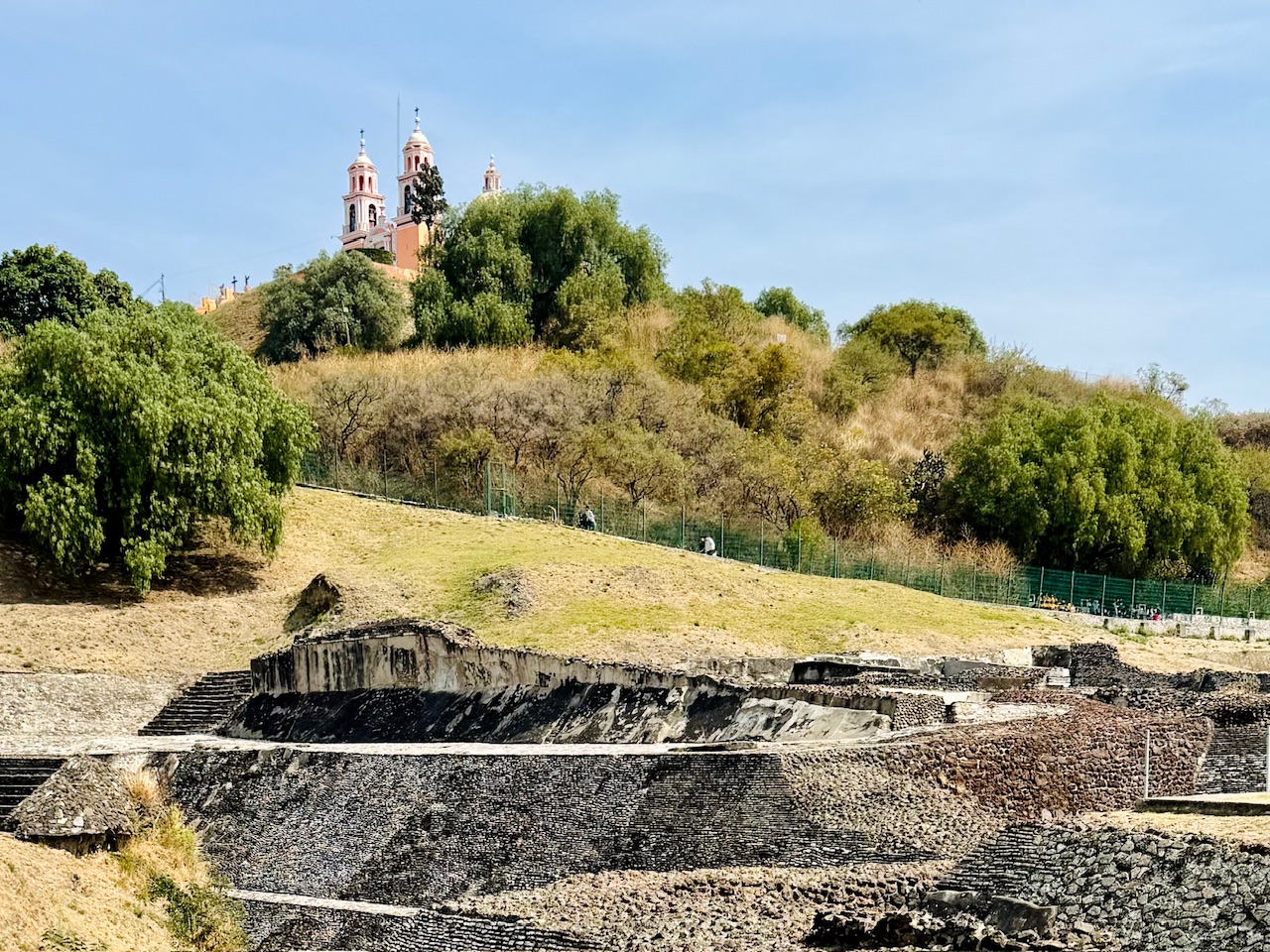
The first thing that you need to understand about visiting the Great Pyramid of Cholula itself is that it’s mostly unexcavated. It is nothing like visiting the various Pyramids of Teotihuacan near Mexico City. For the most part, this pyramid looks like a large natural hill covered in vegetation. And there is actually a Catholic church on top of this pyramid hill.

However, certain lower sections of the pyramid have been uncovered and studied. And you can enter the official Archeological Zone to see those up close.
For many years, visitors would enter the Cholula Archeological Zone through a tunnel, located underneath the hill. This tunnel took them directly through some of the pyramid’s internal structures. However, this tunnel was shut down during the pandemic, and unfortunately has remained closed ever since. You will now walk around the base of the pyramid hill to access the excavated ruins. You’ll see signs across from the aforementioned north ticket building directing you along a pathway to the current entrance.

I’ve marked this entrance gate on Google Maps – in case you want to skip the Site Museum and approach from the hilltop church instead. A pathway leads down to this entrance directly from the church and you can also buy entry tickets here.
Despite the fact that most of the Great Pyramid of Cholula remains covered, entering the Archeological Zone is still very much worth your time – as I’m sure you can appreciate from the photos below.


As you work your way around these excavated ruins, scattered signage will explain the historical significance of the various structures. Barriers do prevent visitors from coming in direct contact with any of the ruins, except for one section. This is called Building F and is one of the newer section of the Great Pyramid of Cholula (built between 500-700 AD). Visitors are allowed to climb up its stairway. I skipped it because we had a much longer ascent coming up next on our day trip to Cholula – an ascent to the top of the Pyramid hill.

3rd Stop – Climbing To The Church On Top
The church on top of the Cholula Pyramid hill is called the Iglesia de Nuestra Señora de los Remedios or Our Lady of Remedies Church. It was constructed by the Spanish in the 16th century. The Spanish had a habit of building churches on top of important native religious sites. And though the Pyramid was covered, it’s likely that both the natives and the Spanish still understood the historic importance of the location.
Today, the church is still a very important local religious building, and we discovered many more people ascending the hill to visit the church than exploring the ancient ruins below. A ticket is not required to enter this part of the Archeological Zone, and entrance to the church and its various viewing platforms is free.

The climb up the hill is fairly steep, and culminates with another climb up the church’s long staircase…

But I do think that the climb is an important part of a day trip to Cholula. The church itself is pretty. But you will also be standing on top of the world’s largest pyramid!

And the views are part of your reward for the climb as well. These include scenic views down to San Pedro Cholula and the massive San Gabriel Franciscan Convent (more on that to come.)

And views over to the modern Puebla skyline…

Plus on clearer days, you can see the nearby volcanoes as well. It’s also useful to know that there are public restrooms (with a small entrance fee) at the top. And a small store if you need something to drink or a snack.
4th Stop – The Zocalo, The Convent, and Lunch
After spending some time atop the hill, we were hungry. Eating a typical local lunch is an important part of any day trip I plan, and this day trip to Cholula Mexico was no different. I’d chosen a highly-rated restaurant near the Zocalo. This would also give us the chance to explore San Pedro Cholula a little bit. And so we made our way down the hill and over to the Zocalo. The journey only takes about 15 minutes on foot.
The Zocalo – also called Plaza de la Concordia – is large and shaded. It features benches and fountains and kiosks with vendors selling local goods. It’s a pleasant place to relax for a bit if you need a shady break on your day trip to Cholula.

Across the street from the Zocalo, you can’t help but notice the grounds and buildings making up the San Gabriel Franciscan Convent. This huge complex was built by Franciscan friars in the mid 1500s. I thought its Gothic design was equal parts castle and church. You can enter the Convent grounds and church for a look around if you wish, though the church interior is fairly plain. We didn’t linger because I knew we had some over-the-top church interiors coming up after lunch.

We ate lunch at a restaurant called Santoua Gastrobar. I chose it because of both its proximity to the Zocalo (only a block away) and its impressive 4.9 Google rating.

We ate our lunch in their pleasant central courtyard. I ordered their Chicken Enmoladas covered in Red Pipian Mole. Moles of various kinds are typical for the Puebla region of Mexico. If you want to learn more about the food of Puebla and its surroundings, check out my post entitled The Best Traditional Food in Puebla Mexico You Can’t Miss.

5th & 6th Stops – Two Famous Mexican Baroque Churches
For the final part of our day trip to Cholula Mexico, I wanted to visit two famous churches that are located in the surrounding area. They are considered two outstanding examples of Mexican Baroque architecture. An alternative final stop, for those more interested in archeology and folk art, would be the Regional Museum of Cholula (which I mentioned earlier.) However, by this point in our trip (which also included Mexico City), we’d seen enough archeological artifacts and folk art.
So what exactly is Mexican Baroque architecture? It’s a highly ornate style of architecture that became very popular in 17th century Mexico. It was heavily influenced by the European Baroque movement of the same time, but incorporated indigenous influences too (including lots of nature-based motifs). Mexican Baroque is much more over-the-top than any example of European Baroque that I’ve ever seen. If you read my post covering things to do in Puebla, then you may remember the golden Capilla del Rosario as a prime example.
Our first Baroque church on this day trip to Cholula was the Templo de Santa María Tonantzintla. It’s located a few miles south of the Zocalo and we used Uber to get there (the cost was 4 USD). Fortunately a wedding had just ended. If we’d arrived any earlier, we would not have been able to enter. And it’s the inside of the church that’s the biggest draw.

However, interior photography of this church is banned and strictly enforced. I did purchase the photo below for a couple dollars at the church so I could show you. I also encourage you to do a Google Image Search of the church for better photos.

The interior is absolutely over-the-top and demands attention. We were able to sit inside and examine all the intricately carved and painted stucco for as long as we wanted. The dense collection of carved images includes Saints and angels, indigenous symbols, and local flora & fauna. It all certainly incorporates everything that defines Mexican Baroque.
The second church we visited on this leg of our time in Cholula Mexico is called San Francisco Acatepec. These two famous Mexican Baroque churches are only separated by a little less than a mile. We used Uber again to get us from one to the other. I was concerned that a driver may not want to take us the short distance, but we didn’t have any problem getting one.
Whereas the Templo de Santa María Tonantzintla is famous for its interior, San Francisco Acatepec is famous for its exterior. Its facade is covered in brightly colored Talavera tiles in intricate patterns. Talavera is a type of tile specific to the Puebla region and uses techniques introduced by the Spanish. This facade is certainly one of the most visually stunning church facades I’ve ever seen.

The inside is impressive too. While not as densely decorated as the Tonantzintla Temple, it’s still a great example of Mexican Baroque style (and photography is allowed).

This was the final stop on our day trip to Cholula. After relaxing for a bit on the church’s park-like grounds, we ordered an Uber and returned to Puebla.
Final Thoughts
So there you have it. Everything we did while visiting Cholula Mexico from nearby Puebla. The easy availability and convenience of Uber made transportation a breeze. The Great Pyramid of Cholula is a must-visit site. The center of San Pedro Cholula is well worth your time – with a great lunch option as well. And I definitely recommend checking out those two unique and unforgettable Mexican Baroque churches. Cholula Mexico absolutely deserves a spot on your Puebla travel itinerary.
If you would like to read more about traveling in Puebla, then check out these posts:
The 9 Most Essential Things To Do In Puebla
Taking The ADO Bus From Mexico City To Puebla
If you will be spending time in Mexico City, then these posts may be helpful as well.
A Practical Mexico City Travel Guide: 12 Important Tips
The 10 Most Essential Things To Do In Mexico City
The Best Traditional Food In Mexico City You Don’t Want To Miss
And finally, if you are curious about how The Great Pyramid Of Cholula archeological site compares to the famous Chichen Itza in the Yucatan, then check out this post: